
HRV and Strength Research: Implications for Strength/Power Athletes?

At this point there is quite a bit of research pertaining to HRV and aerobic exercise/endurance training. However, the application of HRV for strength/power (S/P) athletes is less clear. Today I will discuss the available research pertaining to resistance training (RT) and HRV and share some of my thoughts on the topic.

Unfortunately for S/P athletes, the majority of the research that exists involving RT and HRV do not involve athletes. Rather, most of the research tests the effects that RT has on resting HRV for the purposes of improving health/reducing mortality in elderly or diseased populations. Nevertheless, I will summarize what I’ve read.

Heffernan and colleagues (2007) found no change in HRV following 6 weeks of RT and after 4 weeks of detraining in 25 year old male untrained subjects (n=14).

Cooke and Carter (2005) saw non-significant increases in HRV following 8 weeks of RT compared to control in healthy young adults (n=22).

In middle aged folks with pre-hypertension, aerobic exercise increased HRV while RT resulted in decreases in HRV (Collier et al. 2009). In healthy young adults aerobic training improved HRV (in men but not women) while RT had no effect (Sloan et al. 2009).

Elite endurance athletes had higher HRV at rest compared to Elite power athletes but the power athletes had better resting HRV than control (Kaltsatou et al. 2011). No surprise here.

Following 16 weeks of resistance training, a high intensity group and a low intensity group of healthy older women both improved strength with no significant changes in HRV (Forte et al. 2003). These results were consistent with findings by Madden et al (2006) with the same population however they included an aerobic training group who did see increases in HRV.

RT improved HRV in women with fibromyalgia in a study by Figueroa et al. (2007) but failed to improve HRV in the same population in work by Kingsley et al. (2010).

Compared to 3 months of low intensity training (calisthenics and breathing training), intense training (combined aerobic and strength training) improved HRV at rest and in response to orthostasis (standing) in COPD patients (Camillo et al. 2011). The researchers found that better baseline HRV, muscle force and daily levels of activity were predictors of HRV changes after exercise intervention.

In healthy older men, 12 weeks of eccentric RT resulted in decreased HRV. (Melo et al. 2008)

If one’s goal is to increase HRV via exercise then I would definitely go with aerobic work as this seems to be more effective than RT, though the results are conflicting. Training protocols, subjects, health status, age, HRV measurement position and duration, etc. all vary quite a bit which likely accounts for the conflicting results. I assume that there is a volume/intensity threshold that must be met during RT periods to cause a change in resting HRV. For optimal health it is likely that a combination of aerobic work and RT will offer the most benefits.

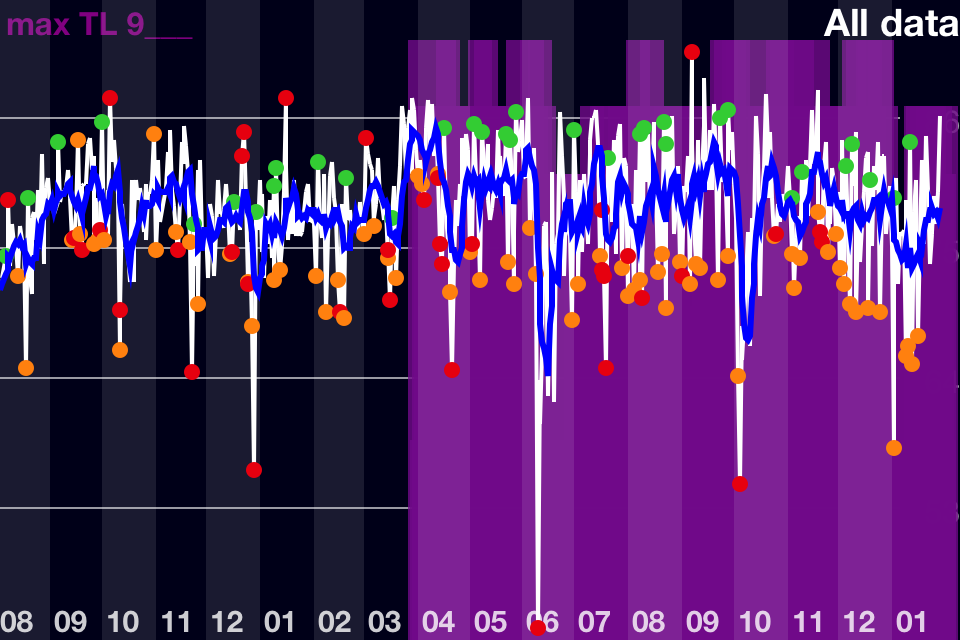
From personal experience, I see much higher scores when I incorporate more aerobic or intermittent conditioning work. In reviewing my all time HRV trend, I can clearly see that over the spring and summer (03-09) of 2012 I had considerably more green scores and higher deflections. This is in line with the time that the weather got nicer and I started doing 30-40 minute runs 3-4x/week (March was unusually warm last year). I got really sick for 2 weeks in June as I discussed here, otherwise I would expect  my trend to be even higher. Once Sept. rolled around I started working full-time again and reduced my aerobic work to 2x/week for about 2o minutes and at a lower intensity at which point baseline declines back to pre-spring/summer levels.
trendalltimejan28

Implications for S/P Athletes

The application of HRV for S/P athletes is obviously different than for elderly or diseased populations. RT is incorporated in training as a means to increase performance, not to increase vagal tone. Therefore, the utility of HRV for this population revolves around its potential ability to:

(Any research I discuss in this section has been cited previously and will not be cited again today, see my older posts for references.)

  • Predict training outcomes

–       Higher HRV at baseline results in improvements in aerobic performance (see here). Would higher baseline HRV result in better S/P improvements? If so, would purposeful manipulation of ANS prior to intensive RT periods via “aerobic” (read “work capacity”) training be of benefit? We already know the importance of GPP but is this relationship mirrored in HRV? If so, HRV may be worth monitoring during these periods.

–       Better basketball and ice hockey performance as well as endurance performance has been correlated with HRV (specifically parasympathetic tone) as I’ve discussed in previous posts. I’m not sure this relationship exists with S/P athletes but it would still be worth testing. Anecdotally, I’ve experience reduced strength performance when HRV is low due to physical fatigue. However, I haven’t really seen strength affected when HRV is low caused by other factors (sleep, other stressors, etc.) Therefore, establishing this relationship must involve careful consideration of these variables.

  • Reflect Recovery Status/Training Load, Overreaching/Non-Functional Overreaching

–       Does overreaching in S/P athletes result in a concomitant decrease in performance and HRV?  Elite female wrestlers were considered non-functionally overreached when performance decreased and HRV was significantly above or below baseline for greater than 2 weeks. Elite tennis players saw significant decreases in HRV but improved performance. Generally in endurance athletes, overreaching will result in decreased performance and a significant increase or decrease in HRV (from baseline).

–       I feel that in S/P athletes, performance probably won’t decrease concurrently with HRV assuming it is a gradual decline as a result progressively increasing training loads. Rather, HRV will probably change first indicating an accumulation of fatigue and performance will fall at some point after if loading persists. Monitoring HRV may be useful to prevent excessive fatigue/overreaching if that isn’t the goal. Perhaps it is also useful in detecting transitions from functional to non-functional overreaching (the point at which HRV changes from overly sympathetic to highly parasympathetic).

–       Does the return to baseline HRV (after overreaching) happen concurrently with return or increase in S/P performance? This was the for case elite swimmers as peak performance occurred concurrently with peak HF values (parasympathetic tone). If so HRV would be a good tool for guiding tapers and establishing best protocols for meet/competition preparation.

–       HRV is an effective tool for guiding aerobic training. Does this apply to S/P athletes? Given that HRV reflects recovery status in S/P athletes (both in the research and anecdotally) and that HRV is sensitive to pretty much all forms of stress, it would seem logical to at least consider HRV in determining daily training. HRV may serve as a guide for determining training frequency and intensity/volume based on individual recovery. More on this topic here. It would be interesting to see HRV guided vs. Pre-planned RT compared in S/P athletes.

  • Guide Periodization

–       HRV will decrease in response to an intense workout. When you perform that workout again and again, your body adapts. The workout is no longer as stressful (decrease in soreness, lack of HRV response, quick recovery, etc. What benefits can HRV offer for adjusting volumes, intensities, exercise selections, frequencies etc. in effort to continually stimulate progress? Is HRV response after a workout any indication of how effective that workout is? Of course there are other factors to consider, not just the amount of stress/fatigue a workout causes. I have repeated workouts with high perceived exertion that have had little effect on HRV. Does that indicate that a change is needed in programming?

It goes without saying that several other factors and variables should be considered when analyzing HRV. HRV is only one variable and is sensitive to a variety of factors that  can influence a result (non-training related stressors, pre-competition anxiety, etc.).

Announcement

This March I will be relocating to Alabama to work in the Human Performance Lab at Auburn University (Montgomery campus) with Dr. Mike Esco. I met Dr. Esco at the NSCA National Conference in RI last summer. Dr. Esco has been researching HRV for several years now. We have several projects tentatively planned and doing an HRV and RT study is one that we’ve been considering. Hopefully we can make it happen.

References

Camillo, C.A. et al. (2011) Improvements of heart rate variability after exercise training and its predictors in COPD. Respiratory Medicine, 105(7): 1054-1062

Cook, W.H., & Carter, J.R. (2005) Strength training does not effect vagal-cardiac control or cardiovascular baroreflex sensitivity in young healthy subjects. European Journal of Applied Physiology, 93: 719-725

Forte, R. et al. (2003) Effects of dynamic resistance training on heart rate variability in healthy older women. European Journal of Applied Physiology, 89: 85-89

Heffernan, K.S. et al. (2007) Heart rate recovery and complexity following resistance exercise training and detraining in young men. American Journal of Physiology – Heart & Circulation Physiology, 293: H3180-H3186

Kaltsatou, A. et al. (2011) The use of pupillometry in the assessment of cardiac autonomic function in elite different type trained athletes. European Journal of Applied Physiology, 111: 2079-2087

Kingsley, J.D., et al (2010). The effects of 12 weeks of resistance exercise training on disease severity and autonomic modulation at rest and after acute leg resistance exercise in women with fibromyalgia. Archives of Physical Medicine & Rehabilitation, 91: 1551-1557

Madden, K.M. et al. (2006) Exercise training and heart rate variability in older adult female subjects. Clinical & Investigative Medicine, 29: 1 – ProQuest

Melo, R.C. et al. (2008) High Eccentric strength training reduces heart rate variability in healthy older men. British Journal of Sports Medicine, 42: 59-63

Sloan, R. P., Shapiro, P.A., DeMeersman, R.E., Bagiella, E., Brondolo, E., McKinley, P.S., Slavov, I., Fang, Y., & Myers, M.M. (2009). The effect of aerobic training and cardiac autonomie regulation in young adults. American Journal of Public Health, 99(5), 921-928
HRV Reflects Detraining – Trend Analysis

Generally when I see a decline in my HRV trend it is because of illness, high stress or significant accumulation of fatigue. However, over the Christmas break I decided to take 2 weeks off from lifting. This decision was based mostly on the fact that I wouldn’t have access to my training facility until after the break. The last time I remember taking this much time off from lifting was back in 2006 when my appendix ruptured and I didn’t get to a hospital until about a 10 days later. I have a nice 6 inch scar on my lower right abdomen to remind me to go see a doctor sooner than later when I feel really sick. Needless to say I was forced to take some time off.

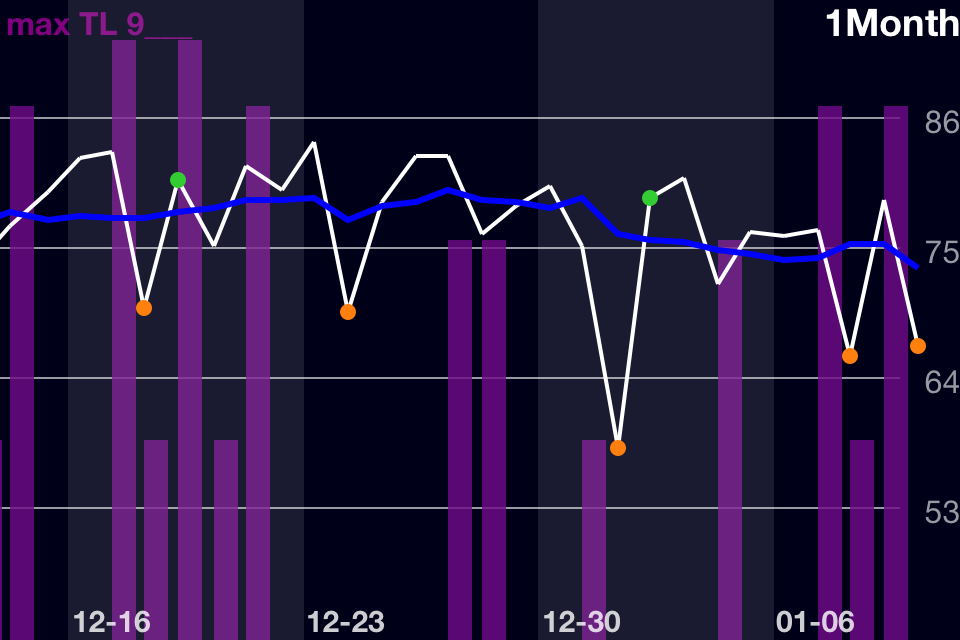
Below are some screen shots of my data that clearly show a steady decline in my HRV trend after approximately one week of training cessation.

RPE Trend Jan 10

–          Above you can see that my last workout before the break was on 12/21 and my first workout back was this Monday (01/07). Between those dates I performed 4 body weight workouts that were largely half-assed. I think my rationale for them was to justify eating all of those high calories meals over the holidays. Without these mini workouts I believe the trend would’ve shown a steeper decline.  HRV baseline dropped from about 80 to about 74 by the end of the detraining period.

–          The steepest dip in the trend came on New Year’s Day as a result of the overeating and drinking from New Year’s Eve. HRV responds poorly to partying.

–          The high point on 01/03 I believe was the result of a day that included a 1 hour massage, hot pools, sauna, steam room, cold tub etc.

–          Training resumed 01/07 and as expected strength levels were noticeably down and a workout that previously could be considered a deload was rated as an 8 and caused a pronounced dip in HRV the following day accompanied with extreme soreness. A clear sign that I’ve detrained. The same happened for Wedneday’s workout (01/09).

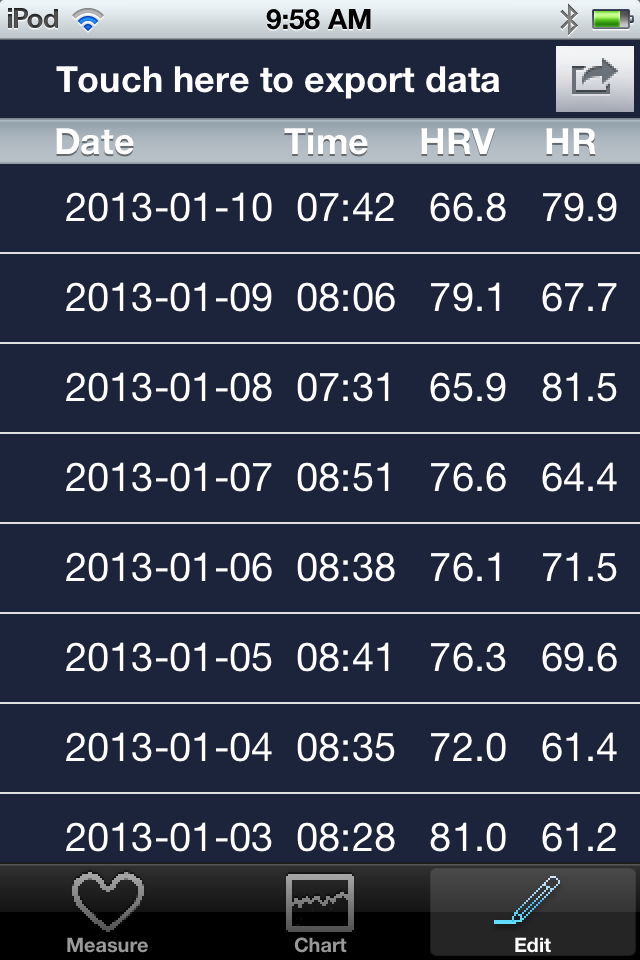
Data Jan 10

–          In the image above you can see that my HRV is lower than usual (baseline is typically around 80). 01/04 stands out to me as a HR of 61.4 is usually accompanied with a high 70’s – low 80’s HRV score but instead HRV is at 72.

trend change Jan 10

–          Above you can see my 3 month trend charted and my Daily, Week and Month change. You can clearly see my baseline HRV steadily decline in late December.

I can think of 2 stuides that investigated the effects of detraining on HRV.

In a study by Gamelin et al (2007), healthy young men (untrained, age 21) were put through 12 weeks of aerobic training followed by 8 weeks of detraining to determine its effect on HRV. An improvement in HRV was seen after the 12 weeks however HRV scores returned to pre-test levels after only 2 weeks of training cessation. “Twelve weeks of aerobic training are sufficient to achieve substantial changes in Heart Rate Variability; and only two weeks of detraining completely reverse these adaptations.”

–          My declining trend in HRV was reflecting my fitness levels, not my strength levels even though they also declined. My trend would’ve likely remained relatively unchanged had I maintained aerobic fitness.

In a recent study by Gutin et al. (2012), obese children were put through a 4 month exercise intervention. RMSSD (a time domain measure of parasympathetic tone) increased after the exercise period and decreased during the detraining period. Below are some excerpts from the study I felt were worth sharing;

“The variables that were significantly associated with individual differences in responsivity to the PT were: (1) the pre-PT RMSSD level—higher pre-PT values were associated with lower change scores (r= −0.28, p = 0.018);”

–          I’m curious to know what accounted for higher pre-training RMSSD values in those subjects. Were they more fit? Were stress levels just considerably lower? Is this a genetic thing? How does resting RMSSD pre-training effect training response? In research I discussed here, higher HRV levels pre-training resulted in larger improvements in fitness vs. the subjects with lower HRV levels pre-training in recreational endurance athletes (Vesterinen et al. (2011) and in soccer players (Oliveira et al. 2012).

“the change in vigorous physical activity (r = 0.25, p = 0.040)—those who increased most in vigorous activity increased most in RMSSD.”

“The primary result of this study was that the RMSSD increased during 4-month periods during which the obese children were engaged in PT, and declined in the 4-month period following cessation of PT in Group 1. This demonstration of what occurred as a result of increases and decreases in controlled vigorous activity supports the idea that regular exercise has a favorable influence on PSA in this population. “

–          These results obviously aren’t shocking and we don’t need HRV to tell us we are detrained. However, monitoring the trends allows us to ensure favorable responses to training. This becomes much more important in athletes or individuals engaging in intense physical training.

Wrap up

Only two weeks of training cessation will result in noticeable decrements in performance and a decrease in resting parasympathetic tone. In the future I will likely perform 1-2 maintenance type workouts each week to maintain strength and fitness levels.

References:

Gamelin, et al. (2007) Effect of training and detraining on HRV in healthy young men. International Journal of Sports Medicine, 28(7): 564-70

Gutin, B., et al. (2012) Heart rate variability in obese children: Relations to total body and visceral adiposity and relations to physical training and detraining. Obesity Research, 8(1): 12-19

Oliveira, RS. et al. (2012) The correlation between heart rate variability and improvement in soccer player’s physical performance. Brazilian Journal of Kinanthropometry, 14(6)

Vesterinen, V. et al. (2011) Heart rate variability in prediction of individual adaptation to endurance training in recreational endurance athletes. Scandinavian Journal of Medicine & Science in Sports, DOI: 10.1111/j.1600-0838.2011.01365.x

A collection of thoughts on HRV and Sports Training

I’ve been having a lot of different thoughts running through my mind recently on various topics surrounding HRV and sports training. A lot of what I say today is based on a lot of the research I’ve been reading and comparing it to my personal experience with my own training and that of my athletes. I’ll try and organize it as best I can but it will be pretty random for the most part. Below are several topics that really deserve entire posts on their own however today I will just provide some quick thoughts on each one.


HRV as a predictor of Performance and or Adaptation

–          HRV appears to predict performance in aerobic athletes. I’ve discussed and cited this research in previous posts. However, in a new study by Chalencon et al. (2012) swim performance in elite athletes was related to parasympathetic activity.

 “the delay needed to return to the initial performance level was highly correlated to the delay required to return to the initial HF power level (p<0.01). The delay required to reach peak performance was highly correlated to the delay required to reach the maximal level of HF power (p = 0.02). Building the ANS/performance identity of a subject, including the time to peak HF, may help predict the maximal performance that could be obtained at a given time.”

See the full text here.

–          Prior to the initiation of intensive training, HRV values appear to predict training outcomes, again, mostly in aerobic athletes. Higher HRV values prior to training lead to better improvements in aerobic performance.  See here for more on this.

–          Higher HRV values on game day are correlated to better performance in amateur Basketball players (Di Fronso et al. 2012).

–          There are several factors that affect an athlete’s performance on any given day. By no means am I suggesting that one is doomed to poor performance if HRV isn’t high. I like the saying “psychology trumps physiology every time”. I think it was Alwyn Cosgrove who said that? Regardless, it’s very true. Furthermore pre-game anxiety can provide a skewed HRV result. More research on this needs to be done.

–           At the moment I do not believe that strength/power can be predicted by HRV on a day to day basis based on my experience. It likely play’s a factor but is certainly not determinant.

HRV as a reflection of recovery status

–          I believe this is one of HRV’s greatest attributes. Your level of fatigue after an intense workout or competition will be reflected in your HRV score. This is valuable for planning the weekly training so as not to load the athlete too soon after competition or too much before competition. In my experience this will usually correlate to perceived recovery. You can typically feel this. However, we cannot feel what our athletes are feeling. See Edmonds et al. (2012) for a study on elite youth rugby players for data on this subject.

–          Chen et al. (2011) showed that after an intense strength workout in elite weightlifters strength and HRV dropped. Strength did not return to baseline (or even above) levels until HRV returned to at or above baseline. This is one of the few studies that used HRV in strength athletes. Most coaches/trainee’s should already be aware that 1RM strength will be reduced for the net 24-48 hours after an intense workout but is cool to see that HRV may reflect the actual time period.

HRV as an early warning sign

–          Fatigue is ok, extreme fatigue is not. HRV is probably one of the first warning signs of fatigue. How much fatigue is okay? I think that first HRV will reflect that physical stress is accumulating. However, until performance changes, we likely needn’t change anything. If training is set up appropriately there should be enough rest/recovery for HRV to approach baseline at the end of each week. This will allow for a slower, more steady decline in the trend as opposed to a more rapid and steep decline which indicates excessive fatigue and overload. Planned overreaching should include the monitoring of several training status markers. HRV will respond early.

–          Researchers found that 3 elite tennis players saw significant reductions in HRV values over pre-season training however performance improved (Thiel et al. 2012). HRV alone does not indicate functional or non-functional overreaching. HRV did not correlate to performance markers but did correlate to other training status markers.

Limitations of Weekly or Monthly HRV Monitoring as opposed to higher frequency monitoring

–          Many studies I’ve read pertaining to athletes have measured HRV periodically (weekly, monthly, pre-post training phase, etc). This is much more practical for coaches as daily HRV measurements can be tedious and compliance can be hard to get from athletes. However, day to day measurements are more valuable as they allow the coach to make training adjustments before excessive fatigue builds up. However, if a coach could only use weekly HRV measurements with athletes I think these measurements would best be done the morning after a recovery day. HRV score at rest will provide the most meaningful information about training load/fatigue.

HRV in Elite vs. Non Elite Athletes

–          I have a lot of thoughts on this but will reserve comment until I do some more research on this. In short, I think there is a difference in how HRV data should be interpreted among these groups.

HRV in competitive athletes vs. Recreation lifters/athletes

–          HRV guided training (planning higher loads when HRV is at or above baseline and reducing them when HRV is below baseline) is likely safer and possibly more effective over longer term training. However, I don’t see how this method will work with athletes during shorter term training periods. Overload is required followed by a taper. Conversely, if your training results are not limited by requiring optimal performance at a certain date, HRV guided training will likely reduce risk of injury, illness, nagging join/soft tissue problems, etc. Recreational lifters would certainly benefit from this style of training.

Final thoughts for today

To be clear, the above are all simply thoughts/hunches I’ve been having. These are all incomplete at the moment and require further elaboration. Moreover, my stance on many of these topics are subject to change. My thoughts are limited by my experience and the research I’ve read. There is still a lot of work that needs to be done on HRV to uncover its potential as a monitoring tool in athletes.

References:

Chalencon S, Busso T, Lacour J-R, Garet M, Pichot V, et al. (2012) A Model for the Training Effects in Swimming Demonstrates a Strong Relationship between Parasympathetic Activity, Performance and Index of Fatigue. PLoS ONE 7(12): e52636. doi:10.1371/journal.pone.0052636

Chen, J., Yeh, D.,  Lee, J., Chen, C.,  Huang, C.,  Lee, S., Chen, C.,  Kuo, T., Kao, C., & Kuo, C. (2011) Parasympathetic nervous activity mirrors recovery status in weightlifting performance after training. Journal of Strength and Conditioning Research, 25(6):  1546-1552

Di Fronso, S. et al. (2012) Relationship between performance and heart rate variability in amateur basketball players during playoffs. Journal for Sports Sciences & Health, 8 (Suppl 1):S1–S70 45

Edmonds, RC., Sinclair, WH., and Leicht, AS. (2012) The effect of weekly training and a game on heart rate variability in elite youth Rugby League players. Proceedings of the 5th Exercise & Sports Science Australia Conference and 7th Sports Dietitians Australia Update. Research to Practice , 19-21 April 2012, Gold Coast, QLD, Australia , p. 183.

Oliveira, RS. et al. (2012a) Seasonal changes in physical performance and HRV in high level futsal players. International Journal of Sports Medicine. DOI: 10.1055/s-0032-1323720

Thiel, C. et al. (2012) Functional overreaching in preparation training of elite tennis professionals. Journal of Human Kinetics, DOI: 10.2478/v10078-011-0025-x