Our new mode-comparison study (aerobic vs. resistance exercise) in young Black men, an understudied group at elevated cardiovascular risk, showed that:
-RE induces a more pronounced and sustained cardiovascular and autonomic strain during the early post-exercise period than AE
-This was characterized by elevated central afterload, reduced myocardial oxygen supply–demand balance, and delayed parasympathetic reactivation
-Mode differences occurred despite similar session duration and exercise HR between bouts
-While both modes are generally safe/recommended, exercise Rx should consider mode-specific recovery differences, particularly when central afterload or autonomic recovery is a consideration
Highlights from our new study for the special issue on “Wearables and the ANS” in Autonomic Neuroscience (full text below).
Aim 1: Test the validity of the Polar H10 vs ECG for HRV and standard cardiac autonomic reflex tests using a time-efficient protocol (see Pic 3).
Aim 2: Determine the extent to which supine RMSSD captures variability in other cardiovagal markers (deep breathing test, orthostatic reflex test, standing RMSSD).
Findings:
Relative agreement was near-perfect across all metrics, with negligible bias, narrow 95% limits of agreement, and MAPE consistently <1%.
Supine HRV explained between none and half of the variance in markers of cardiovagal function from separate assessments.
We explain why supine HRV is limited as a standalone index with examples (see Pic 4).
Instead of conventional supine HRV, which provides 1 assessment in ~10 min (5 min stabilization, 5 min recording), consider this shorter (8 min) protocol that includes 4 distinct assessments for a more comprehensive evaluation.
For remote monitoring, chest-strap ECG assessment should be prioritized over optical wearable sensors such as wristbands and smartwatches, which remain susceptible to substantial error in HRV estimation.
The H10’s ease of use, low cost, and lack of disposable electrodes make it well-suited for remote monitoring and field-based testing, while its high measurement accuracy supports its use in laboratory or clinical settings when traditional ECG is impractical or unavailable.
Our recent study in national-level wrestlers shows that post‑match foam rolling, and to a lesser extent static stretching, may modestly improve acute post-match HRV recovery vs. passive rest, with neutral effects on CMJ performance. More research needed. Full text below.
Our recent paper evaluating acute HRV and blood pressure responses to two different styles of upper-body resistance exercise in trained men shows that:
– For greater hypotensive effects, traditional sets > cluster sets – For faster cardiac-parasympathetic reactivation, cluster sets > traditional sets
Highlights from our latest study in JSCR. Full-text available here.
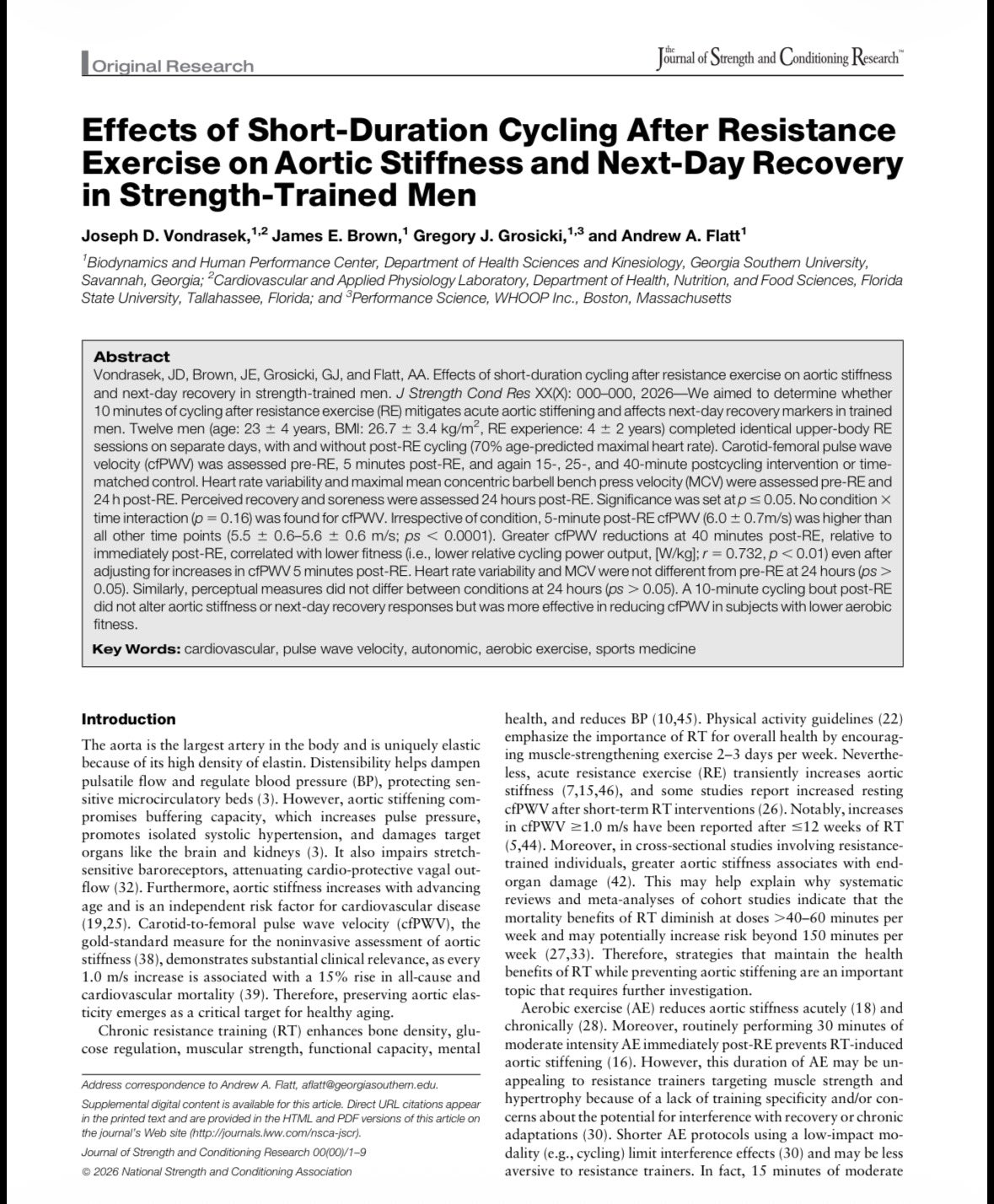
We aimed to determine how 10 min of post-resistance exercise cycling affects aortic stiffness responses and next day recovery markers in well-trained men.
– A 10-min bout of air bike cycling was ineffective at countering acute RE-induced increases in cfPWV (aortic stiffness), likely because of the rapid and unanticipated cfPWV return to baseline by Post-RE 15min in both conditions (intervention & control).
– Accelerated post-RE cfPWV normalization may be an adaptation to habitual RE, as acute RE-induced aortic stiffness typically persists for >60 min in less experienced lifters.
– Thus, targeting the attenuation of acute post-RE increases in cfPWV is likely unnecessary, but whether the intervention exerts chronic effects, such as limiting long-term RT-induced increases in resting cfPWV, remains TBD.
– Despite no effect of the intervention on cfPWV at the group level, it altered changes at the individual level, such that those with a lower relative cycling power output at the target HR exhibited greater reductions in cfPWV.
– This may indicate that lifters with lower aerobic fitness may derive greater AE-induced destiffening effects after acute RE. – Finally, the AE intervention neither enhanced nor impaired recovery indicators (HRV, subjective, barbell velocity), alleviating concerns about short-term AE interfering with next-day recovery status or performance.
We aimed to quantify associations between resting heart rate variability (HRV) and ambulatory blood pressure (BP) characteristics in young adults. Thirty-two apparently healthy young adults (50% male) were included in the study. Short-term HRV was obtained via electrocardiography in the laboratory following an overnight fast to determine the mean RR interval, standard deviation of normal RR intervals (SDNN), and root-mean square of successive differences (RMSSD). Participants left the laboratory wearing an ambulatory BP monitor for 24 h to determine awake, asleep, and overall systolic and diastolic BP, and asleep BP dipping ratios. In males, higher SDNN and RMSSD were associated with lower asleep systolic and diastolic BP, and greater systolic BP dipping, with SDNN also associated with diastolic BP dipping (Ps <0.05). In females, higher mean RR, RMSSD, and SDNN were associated with lower awake diastolic BP, and RMSSD with lower overall diastolic BP (Ps <0.05). Our findings indicate potential sex differences in how cardiac-autonomic function associates with BP regulation throughout the day. In males, HRV showed stronger associations with nocturnal BP characteristics, whereas in females, HRV associations were more pronounced with daytime BP.
Following a ~2-week family trip, I was relatively detrained. As expected, my standing HRV trend worsened while away with lower and less stable values, reflecting reduced fitness, travel effects, routine change, etc. For my latest n=1 experiment, I decided to track my fitness improvement as I progressively resumed training when I returned home. With increases in aerobic fitness, HRV typically improves by increasing and becoming more stable. I track both nocturnal HRV and post-waking HRV in the standing position. Which of these two is more sensitive to my change in fitness?
What did I do?
I compared associations between my submaximal exercise heart rate at a fixed intensity (HRex, an indicator of aerobic fitness) and both nocturnal and standing RHR and HRV over a 4-week period.
Note: All tools used for this self-experiment were wearable devices that I validated on myself (examples below). However, the accuracy of a device can vary from person to person depending on various factors. For example, many HRV apps show greater error with higher HRV values. Additionally, HRex from a wearable is often less accurate at higher intensities, in less stable conditions, in cold weather, etc. Thus, I encourage everyone to test the accuracy of your own device if you’re able to do so. Otherwise, refer to published agreement studies.
Why did I do it?
My nocturnal and standing HRV often show divergent patterns. If I were to guide training with HRV, which should I focus on? I’ve written about this issue extensively. Here’s a previous example comparing my nocturnal HRV vs. standing HRV during and after COVID-19 infection.
How did I do it?
HRex: I measured HRex during a 20-min treadmill walk (3.7 mph, 1.5% grade, ~50-60% HRmax) every morning at ~7 AM. HRex was measured with the Polar Vantage V3. The mean HR from the last 3 min of each session was used to determine HRex via Polar Flow. I previously compared the Vantage V3 vs. Polar H10 during various exercise sessions and found near identical average HRex values (within 1 bpm, example from treadmill walk below).
Nocturnal Values: Nocturnal HR and HRV (RMSSD) were measured with Oura Ring 4. I previously compared Oura to ECG during a night of sleep and found good agreement (2 ms difference, image below). One outlier sleep HRV value was removed (very high RMSSD, 106 ms spike vs ~70 ms average) which occurred with frequent breathing disturbances reported in the app (i.e., episode of sleep apnea, which happens when I overeat with a later dinner time).
Standing Values: Standing HR/HRV were measured after waking, peeing, and logging body mass. I used the Kubios HRV app paired with a Polar Verity Sense worn around the forearm. The sample duration was 1 min. I compared simultaneous HRV measurements performed with the Vertiy Sense and H10 via the Kubios app and found good agreement. Here is an example comparison below using Kubios software.
What did I find regarding trends over time?
HRex: Consistent with a progressive increase in aerobic fitness, HRex tended to decrease over time.
Nocturnal HRV: Consistent with a progressive increase in aerobic fitness, sleep HR tended to decrease over time. However, inconsistent with fitness improvement, sleep HRV tended to decrease over time.
Standing HRV: Standing HR tended to decrease over time and standing HRV tended to increase over time. Each as expected with an increase in fitness. Figures below showing trends for all parameters across time.
What did I find regarding associations between HRex and HR/HRV values?
Nocturnal Values: Sleep HR was associated with HRex (r = 0.58) in the expected direction, such that when sleep HR was lower, HRex also tended to be lower. Sleep HRV was not strongly associated with HRex and the slope was directionally opposite of what one would expect (r = 0.25). This means that when sleep RMSSD was higher, HRex tended to be higher. Figure below for nocturnal values.
Standing Values: The association between standing HR and HRex was directionally as expected (lower HR associated with lower HRex) but not very strong (r = 0.32). Standing HRV was associated with HRex in the expected direction (r = -0.64), indicating that higher standing HRV was associated with lower HRex. Standing HRV provided the strongest correlation coefficient with HRex. Figure below for standing values.
A strong correlation between my standing RMSSD and HRex is consistent with a previous case study we published in a pro soccer player who showed a similar association with seated upright RMSSD and the heart rate-running speed index (effectively, HRex). See scatter plot below. It didn’t matter if we used a 1 min or a 5 min HRV measure, the associations were the same.
What’s going on with sleep HRV?
My sleep HR was consistently <55 bpm. When HR drops below this threshold, HRV often diminishes. This is because cholinergic receptors on the heart become saturated at very high levels of cardiac parasympathetic activity (i.e. high parasympathetic activity = high vagal discharge of acetylcholine). As a result, phasic modulation decreases, leading to reduced beat-to-beat variability. In the figure below, you can see that the association between sleep HR and RMSSD is counterintuitively positive rather than negative. As my sleep HR decreased, RMSSD decreased as well. Contrastingly, as standing HR decreased, RMSSD increased.
Parasympathetic saturation is a well documented effect. In fact, the very first studies to compare HRV-guided versus pre-planned training by Kiviniemi et al. (2007, 2010) intentionally used standing HRV measures to counteract potential saturation effects that commonly occur when lying down. See screenshots below from the Methods sections.
Therefore, If your sleep HR is <55 bpm, I would strongly encourage you to create a scatter plot of your HR and HRV to determine if this applies to you. It’s critically important to understand that in cases of saturation, HRV does not reflect parasympathetic activity.
I believe there are also other reasons to opt for standing HRV over nocturnal HRV (discussed here).
Conclusion
There was a tendency for greater cardiac efficiency during exercise when standing HRV was higher. Conversely, there was a tendency for greater internal load in response to a fixed stimulus when standing HRV was reduced.
Considering that I cannot use sleep HRV to reliably reflect cardiac-parasympathetic activity due to saturation, and that standing HRV provided the strongest association with HRex, I will continue to use standing HRV as my primary metric.
New study: “Effects of Position and Injury Status on Associations Between Preseason Workload and Heart-Rate Variability Profiles in American College Football Players”
Main findings:
The effect of very high preseason training loads on HRV in college football players varies by position group.
Skill group players who consistently performed the highest total workloads had the most stable HRV, which typically reflects high/increasing fitness.
Conversely, mid-skill group players who performed the highest total workloads had the least stable HRV (often reflects fatigue), along with greater daily variation in high intensity outputs.
Thus, skill players tolerated high loads with stable HRV while mid-skill players better maintained high intensity movement and stable HRV at more moderate workloads.
HRV tended to be lower in those who were playing hurt (“go as can” status), and we suspect that the association between HRV and injury is bidirectional (low HRV precedes injury, injury causes reduced HRV).
New study of ours comparing the Biostrap Kairos wristband to ECG for HRV assessment.
The Kairos wristband offers on-demand heart rate variability (HRV) assessment through its “Spot Check” feature, enabling standardized recordings for clinical, research, or self-tracking purposes, but its validity is untested. Therefore, we compared the Kairos wristband to electrocardiography (ECG) for resting HRV assessment in young adults, and investigated the influence of skin pigmentation (M-index) on measurement accuracy.
Here’s a new study from our lab entitled “Self-recorded heart rate variability profiles are associated with health and lifestyle markers in young adults”. The full text can be accessed for free through this link: https://rdcu.be/cUd9T. A practical summary is provided below.
We’ve been tracking ANS status in athletes via daily ultra-short HRV for nearly 10 years now. In general, we (and others) have found that higher and more stable values are often observed in athletes who are more aerobically fit and who are adapting well to training. Contrastingly, lower and less stable values are commonly observed when athletes are stressed, fatigued from training, and not adapting favorably.
There is also a sizable body of research showing that isolated HRV derived from clinical and laboratory assessment is associated with a variety of health and lifestyle markers in general and clinical populations. Healthier individuals tend to have higher vagal-mediated HRV, are less likely to develop chronic diseases, and often live longer. There is also research showing that less stable HR parameters (i.e., greater day-to-day fluctuation) are independently associated with an increased risk of cardiovascular events in older adults. Importantly, HRV is modifiable. With lifestyle improvement, one can make their HRV higher and more stable. Here’s a case example showing substantial improvements in HRV and other healthy markers with improvements in various lifestyle factors: https://hrvtraining.com/2021/08/10/increasing-hrv-and-cardiovascular-health-10-year-case-study/.
Thus, similar to how we track HRV in athletes to guide training and monitor adaptations, we hypothesize that regular folks can track their HRV to guide lifestyle behaviors towards those that increase cardiac-parasympathetic function, thereby supporting health and longevity. However, no previous investigations have examined the association between self-recorded HRV and health/lifestyle metrics in young adults using accessible HRV tools and ultra-short (60-s) daily recordings. Therefore, that’s what we set out to do.
We had subjects perform 60-s post-waking HRV recordings in the supine and standing position with a cost-free smartphone application and Bluetooth chest strap for 7 days. They also wore an Actigraph on their wrist to measure activity levels and sleep profiles. Following the observation period, we obtained a variety of cardiovascular, metabolic, and psychoemotional health markers in the laboratory.
As anticipated, higher and/or more stable HRV parameters were generally associated with more favorable cardiovascular (higher VO2max, lower systolic and diastolic blood pressure, and lower aortic stiffness), metabolic (lower body fat percentage, fasting glucose, and LDL-C), and psychoemotional (lower perceived stress) health markers. Some variation between sexes and recording positions were noted. Additionally, most, but not all, associations weakened after adjusting for VO2max, supporting previous work indicating that increasing fitness is one of the most effective ways to increase HRV and derive health benefits associated with increased parasympathetic (and reduced sympathetic) modulation. For more details and conclusions, see the full text here: https://rdcu.be/cUd9T