Highlights from our latest study in JSCR. Full-text available here.
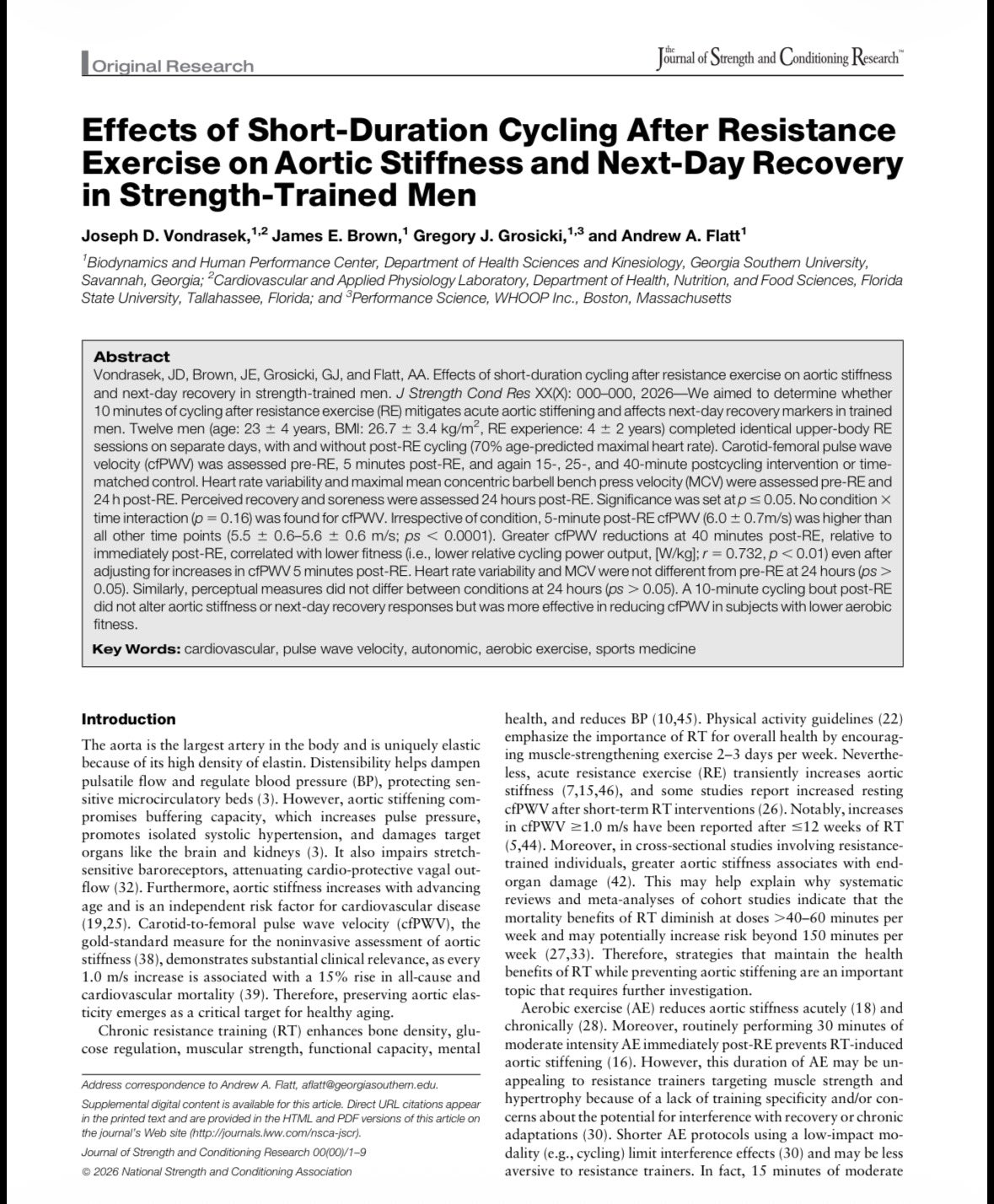
We aimed to determine how 10 min of post-resistance exercise cycling affects aortic stiffness responses and next day recovery markers in well-trained men.
– A 10-min bout of air bike cycling was ineffective at countering acute RE-induced increases in cfPWV (aortic stiffness), likely because of the rapid and unanticipated cfPWV return to baseline by Post-RE 15min in both conditions (intervention & control).
– Accelerated post-RE cfPWV normalization may be an adaptation to habitual RE, as acute RE-induced aortic stiffness typically persists for >60 min in less experienced lifters.
– Thus, targeting the attenuation of acute post-RE increases in cfPWV is likely unnecessary, but whether the intervention exerts chronic effects, such as limiting long-term RT-induced increases in resting cfPWV, remains TBD.
– Despite no effect of the intervention on cfPWV at the group level, it altered changes at the individual level, such that those with a lower relative cycling power output at the target HR exhibited greater reductions in cfPWV.
– This may indicate that lifters with lower aerobic fitness may derive greater AE-induced destiffening effects after acute RE. – Finally, the AE intervention neither enhanced nor impaired recovery indicators (HRV, subjective, barbell velocity), alleviating concerns about short-term AE interfering with next-day recovery status or performance.
Here’s a new study from our lab entitled “Self-recorded heart rate variability profiles are associated with health and lifestyle markers in young adults”. The full text can be accessed for free through this link: https://rdcu.be/cUd9T. A practical summary is provided below.
We’ve been tracking ANS status in athletes via daily ultra-short HRV for nearly 10 years now. In general, we (and others) have found that higher and more stable values are often observed in athletes who are more aerobically fit and who are adapting well to training. Contrastingly, lower and less stable values are commonly observed when athletes are stressed, fatigued from training, and not adapting favorably.
There is also a sizable body of research showing that isolated HRV derived from clinical and laboratory assessment is associated with a variety of health and lifestyle markers in general and clinical populations. Healthier individuals tend to have higher vagal-mediated HRV, are less likely to develop chronic diseases, and often live longer. There is also research showing that less stable HR parameters (i.e., greater day-to-day fluctuation) are independently associated with an increased risk of cardiovascular events in older adults. Importantly, HRV is modifiable. With lifestyle improvement, one can make their HRV higher and more stable. Here’s a case example showing substantial improvements in HRV and other healthy markers with improvements in various lifestyle factors: https://hrvtraining.com/2021/08/10/increasing-hrv-and-cardiovascular-health-10-year-case-study/.
Thus, similar to how we track HRV in athletes to guide training and monitor adaptations, we hypothesize that regular folks can track their HRV to guide lifestyle behaviors towards those that increase cardiac-parasympathetic function, thereby supporting health and longevity. However, no previous investigations have examined the association between self-recorded HRV and health/lifestyle metrics in young adults using accessible HRV tools and ultra-short (60-s) daily recordings. Therefore, that’s what we set out to do.
We had subjects perform 60-s post-waking HRV recordings in the supine and standing position with a cost-free smartphone application and Bluetooth chest strap for 7 days. They also wore an Actigraph on their wrist to measure activity levels and sleep profiles. Following the observation period, we obtained a variety of cardiovascular, metabolic, and psychoemotional health markers in the laboratory.
As anticipated, higher and/or more stable HRV parameters were generally associated with more favorable cardiovascular (higher VO2max, lower systolic and diastolic blood pressure, and lower aortic stiffness), metabolic (lower body fat percentage, fasting glucose, and LDL-C), and psychoemotional (lower perceived stress) health markers. Some variation between sexes and recording positions were noted. Additionally, most, but not all, associations weakened after adjusting for VO2max, supporting previous work indicating that increasing fitness is one of the most effective ways to increase HRV and derive health benefits associated with increased parasympathetic (and reduced sympathetic) modulation. For more details and conclusions, see the full text here: https://rdcu.be/cUd9T


 HRVtraining