Nocturnal versus standing HRV for reflecting changes in fitness

Background:

Following a ~2-week family trip, I was relatively detrained. As expected, my standing HRV trend worsened while away with lower and less stable values, reflecting reduced fitness, travel effects, routine change, etc. For my latest n=1 experiment, I decided to track my fitness improvement as I progressively resumed training when I returned home. With increases in aerobic fitness, HRV typically improves by increasing and becoming more stable. I track both nocturnal HRV and post-waking HRV in the standing position. Which of these two is more sensitive to my change in fitness?

What did I do?

I compared associations between my submaximal exercise heart rate at a fixed intensity (HRex, an indicator of aerobic fitness) and both nocturnal and standing RHR and HRV over a 4-week period.

Note: All tools used for this self-experiment were wearable devices that I validated on myself (examples below). However, the accuracy of a device can vary from person to person depending on various factors. For example, many HRV apps show greater error with higher HRV values. Additionally, HRex from a wearable is often less accurate at higher intensities, in less stable conditions, in cold weather, etc. Thus, I encourage everyone to test the accuracy of your own device if you’re able to do so. Otherwise, refer to published agreement studies.

Why did I do it?

My nocturnal and standing HRV often show divergent patterns. If I were to guide training with HRV, which should I focus on? I’ve written about this issue extensively. Here’s a previous example comparing my nocturnal HRV vs. standing HRV during and after COVID-19 infection.

How did I do it?

HRex: I measured HRex during a 20-min treadmill walk (3.7 mph, 1.5% grade, ~50-60% HRmax) every morning at ~7 AM. HRex was measured with the Polar Vantage V3. The mean HR from the last 3 min of each session was used to determine HRex via Polar Flow. I previously compared the Vantage V3 vs. Polar H10 during various exercise sessions and found near identical average HRex values (within 1 bpm, example from treadmill walk below).

Nocturnal Values: Nocturnal HR and HRV (RMSSD) were measured with Oura Ring 4. I previously compared Oura to ECG during a night of sleep and found good agreement (2 ms difference, image below). One outlier sleep HRV value was removed (very high RMSSD, 106 ms spike vs ~70 ms average) which occurred with frequent breathing disturbances reported in the app (i.e., episode of sleep apnea, which happens when I overeat with a later dinner time).

Standing Values: Standing HR/HRV were measured after waking, peeing, and logging body mass. I used the Kubios HRV app paired with a Polar Verity Sense worn around the forearm. The sample duration was 1 min. I compared simultaneous HRV measurements performed with the Vertiy Sense and H10 via the Kubios app and found good agreement. Here is an example comparison below using Kubios software.

What did I find regarding trends over time?

HRex: Consistent with a progressive increase in aerobic fitness, HRex tended to decrease over time.

Nocturnal HRV: Consistent with a progressive increase in aerobic fitness, sleep HR tended to decrease over time. However, inconsistent with fitness improvement, sleep HRV tended to decrease over time.

Standing HRV: Standing HR tended to decrease over time and standing HRV tended to increase over time. Each as expected with an increase in fitness. Figures below showing trends for all parameters across time.

What did I find regarding associations between HRex and HR/HRV values?

Nocturnal Values: Sleep HR was associated with HRex (r = 0.58) in the expected direction, such that when sleep HR was lower, HRex also tended to be lower. Sleep HRV was not strongly associated with HRex and the slope was directionally opposite of what one would expect (r = 0.25). This means that when sleep RMSSD was higher, HRex tended to be higher. Figure below for nocturnal values.

Standing Values: The association between standing HR and HRex was directionally as expected (lower HR associated with lower HRex) but not very strong (r = 0.32). Standing HRV was associated with HRex in the expected direction (r = -0.64), indicating that higher standing HRV was associated with lower HRex. Standing HRV provided the strongest correlation coefficient with HRex. Figure below for standing values.

A strong correlation between my standing RMSSD and HRex is consistent with a previous case study we published in a pro soccer player who showed a similar association with seated upright RMSSD and the heart rate-running speed index (effectively, HRex). See scatter plot below. It didn’t matter if we used a 1 min or a 5 min HRV measure, the associations were the same.

What’s going on with sleep HRV?

My sleep HR was consistently <55 bpm. When HR drops below this threshold, HRV often diminishes. This is because cholinergic receptors on the heart become saturated at very high levels of cardiac parasympathetic activity (i.e. high parasympathetic activity = high vagal discharge of acetylcholine). As a result, phasic modulation decreases, leading to reduced beat-to-beat variability. In the figure below, you can see that the association between sleep HR and RMSSD is counterintuitively positive rather than negative. As my sleep HR decreased, RMSSD decreased as well. Contrastingly, as standing HR decreased, RMSSD increased.

Parasympathetic saturation is a well documented effect. In fact, the very first studies to compare HRV-guided versus pre-planned training by Kiviniemi et al. (2007, 2010) intentionally used standing HRV measures to counteract potential saturation effects that commonly occur when lying down. See screenshots below from the Methods sections.

Therefore, If your sleep HR is <55 bpm, I would strongly encourage you to create a scatter plot of your HR and HRV to determine if this applies to you. It’s critically important to understand that in cases of saturation, HRV does not reflect parasympathetic activity.  

I believe there are also other reasons to opt for standing HRV over nocturnal HRV (discussed here).

Conclusion

There was a tendency for greater cardiac efficiency during exercise when standing HRV was higher. Conversely, there was a tendency for greater internal load in response to a fixed stimulus when standing HRV was reduced.

Considering that I cannot use sleep HRV to reliably reflect cardiac-parasympathetic activity due to saturation, and that standing HRV provided the strongest association with HRex, I will continue to use standing HRV as my primary metric.

Sleep duration and Nocturnal vs. Standing HRV recovery from COVID

Many of us have learned the hard way to stop training when we’re sick, and to ease back into it as we recover. In 2012, I contracted the hand/foot/mouth (HFMD) virus from my nephews. It was awful. After symptoms resolved, my training resumed with a deload week. Taking it easy, it took ~9 days after symptoms cleared for my 7-day rolling HR and LnRMSSD averages to return to within 1 standard deviation (SD) of pre-infection values (14-d baseline) (Fig. 1). These HRV values were obtained in the standing position after waking.

Fig 1. RMSSD and HR responses to HFMD virus.

I’ve observed the same general standing HRV pattern in every subsequent illness, with the time-course of HRV recovery proportional to the severity of illness. I recently had COVID. Predictably, I observed a very similar HRV response. It took ~10 days post-symptom resolution for my standing values to normalize. Training was even more conservative than post-HFMD since I’m getting older (and somewhat wiser, hopefully).

However, unlike in previous cases of illness, this time I also had nocturnal HRV and sleep data from my Oura ring. Without careful interpretation, it would seem that HRV responses (standing vs. nocturnal) reveal largely contradictory responses. This is problematic if one were trying to use HRV, or “Readiness” scores based largely on HR or HRV, to guide training decisions post-illness (or any time for that matter). Which should you follow? The data and my interpretations are shared below.

Supine vs. Standing HRV

First, I’ll address why nocturnal and standing HRV are different. Nocturnal HRV is acquired during sleep, representing parasympathetic function under passive conditions, largely undisturbed by our wakeful thoughts and emotions. HRV should peak during sleep, reflecting healthy circadian variation in ANS activity, which is associated with nocturnal blood pressure dipping and a lower risk of cardiovascular diseases. Contrastingly, standing HRV captures the ANS response to a mild challenge. Blood wants to pool in the legs when standing, which would cause hypotension, limit blood supply to the brain, and cause dizziness or fainting if not for properly functioning counteractive mechanisms. Baroreceptors detect reduced blood pressure following postural change, resulting in a reflexive increase in HR and vasoconstriction to maintain blood pressure. In healthy people, there is a sudden HR response (↓parasympathetic activity) followed by a quick recovery. However, when sick or stressed (mental, physical, etc.), the HR response may be exaggerated and slower to recover.

By measuring HR/HRV ~1 min after standing, we can observe how efficiently the ANS is adapting to a minor challenge. In fact, ANS testing in clinical settings typically involves a series of reflex tests. These include HR or HRV responses to deep breathing, orthostatic stress (standing), isometric handgrip, etc. This is because abnormalities are more likely to be revealed when the ANS is challenged. It always seemed intuitive to me that if we wanted to use HRV as an indicator of how we may adapt to physical stress (i.e. training), we should measure HRV in response to a little bit of physical stress.  

COVID

Four hours before my flight to San Diego for the ACSM Annual meeting, I was walking the dog when my wife texted me a picture of her positive COVID test. Thus, I cancelled my flights, cared for my ill wife, and waited to get sick. Two days later, I woke up with a sinus headache and both my nocturnal and standing HRV were substantially reduced (good agreement between responses). A sore throat came on day 2 and stuck around for 5-6 days. My average ambulatory HR measured continuously throughout the first few days by Oura was ~10 bpm higher than usual, despite being more sedentary. My appetite increased dramatically to compensate. I attempted some HRV biofeedback sessions with limited success (screenshot comparison of sessions with and without COVID below). Coughing up phlegm was my last symptom to clear.

Fortunately, work stress and other obligations were minimal throughout this period. Light exercise (zone 2 air bike) and desk work resumed on 06/09, corresponding with my first “normal” standing daily RMSSD value. Thereafter is where nocturnal and standing HRV patterns diverge (Fig. 2). Nocturnal RMSSD increases above baseline post-symptoms, whereas standing RMSSD remains mostly suppressed.

Fig 2. Nocturnal and Standing HR and HRV trends pre-, during, and post-COVID symptoms

Thus, Oura is telling me that my “readiness” is high (some of the highest scores I’ve recorded to date) (Fig. 3). Contrastingly, standing RMSSD values are telling me to gear down, that things aren’t quite normal yet.

Fig. 3. Sleep duration and daily Oura Readiness scores.

Why the discrepancy?

Although I was feeling pretty much back to normal post-symptoms, when I resumed work and light exercise, I was exhausted by the end of the day (but not during the day). I was falling asleep on the couch by ~9 pm (normal bed time 10-10:30 pm). I was also sleeping longer than usual (Fig. 3). My average total sleep duration for May was 401 min, whereas for the first 10 days post-symptoms, I averaged 429 min. Clearly, I had increased sleep needs. Interestingly, my total sleep time was the strongest correlate (vs. sleep stages, efficiency, etc.) of my nocturnal RMSSD (Fig 4).

Fig. 4. Association between nocturnal RMSSD and HR
Grey dots represent baseline. Vertical line at 401 min represents mean sleep duration from previous month

However, the association between sleep duration and standing HRV reverses post-symptoms (Fig. 5). You can see in Fig. 2 and Fig 5. that my standing RMSSD trends to baseline as my total sleep duration trends to baseline. Thus, my standing HRV remained suppressed apparently until my sleep duration returned towards normal. Reduced sleep duration in this instance likely reflects that my body no longer needed the extra rest, and by returning to baseline at this time, my standing HRV suggests the same thing. I also stopped falling asleep on the couch and returned to my habitual sleep/wake time.

Fig. 5. Association between standing RMSSD and sleep duration during and post-symptoms.
Vertical line at 401 min represents mean sleep duration from previous month.

Saturation?

My first instinct was that my increase in nocturnal RMSSD was probably a result of reduced saturation effects. This is a poorly understood concept and creates a lot of confused wearable users. Essentially, there is an inverse linear relationship between HR and RMSSD (as HR decreases, RMSSD increases) until ~50-55 bpm, at which point RMSSD starts to decrease, reflecting a quadratic relationship. This phenomenon is well documented in numerous studies, yet is poorly conveyed to users by wearable companies. There’s a strong possibility that if your HR is <50 bpm (i.e., fit individuals), your nocturnal RMSSD is reduced due to saturation. The mechanism seems to be that very high parasympathetic activity saturates cholinergic receptors in the myocardium, resulting in sustained inhibitory effects on the SA node, causing a slow HR with reduced respiratory sinus arrhythmia (thus, reduced RMSSD).

Practically, this means that if you are typically experiencing saturation due to a very low HR (as I often do with nocturnal value), increased stress can increase your HR out of the saturation zone and thus result in increased RMSSD. This is entirely counterintuitive because you’d expect more stress = increased HR and reduced RMSSD. I receive more emails from wearable users over this issue than any other.

Fig. 6 below clearly shows a quadratic association between nocturnal RMSSD and HR, suggesting that reduced saturation effects may be contributing to the increased nocturnal RMSSD post-symptoms. This is unlike the expected linear association observed in my standing values, where HR is mostly > 55 bpm (Fig).

Fig. 6. Association between HR and RMSSD for nocturnal and standing values.

However, when I adjust for HR (by dividing RMSSD by HR), it shows that nocturnal RMSSD was increased, independent of changes in HR (Fig. 7). This suggests that the elevated RMSSD was unlikely due to reduced saturation effects, alone. Thus, in this case, it seems that RMSSD was increased due to greater parasympathetic modulation.

Fig. 7. Nocturnal and standing RMSSD/HR

While it’s tempting to interpret longer sleep duration (often a good thing) and higher nocturnal RMSSD (also often a good thing) as signs of high readiness to train, that’s obviously incorrect in this context. I interpret these responses to reflect higher recovery demands and processes from lingering effects of the illness, plus the additional stress from resuming work and exercise (even at low intensity and volume). This is supported by the fact that my ANS was not yet able to respond as efficiently as usual to the minor stress of standing within the first several days post-symptoms.

Conclusion

Nocturnal values provided valuable insight regarding my sleep patterns and nightly ANS activity during and after COVID. However, taken alone and out of context, one could easily misinterpret these changes to support resumption of intense training. Thus, standing HRV also provided important insight, showing that my ANS was poorly adaptive to a mild physical challenge post-symptoms. Taken together and in context, the appropriate interpretation is likely that I was still adjusting and recovering from the illness (greater sleep/recovery needs and enhanced nocturnal parasympathetic activity to support them), and that intense training would be poorly tolerated (suppressed HRV in response to standing, a minor physical challenge). Consequently, exercise remained light (air bike, body weight circuits, deload-style lifting) until standing HRV finally normalized at ~10 days post-symptoms, which corresponded fairly well with the return of my sleep duration to normal values. Therefore, nocturnal and standing HRV were both valuable, but different. These are not interchangeable values.

I’ll finish with a brief thought on “Readiness” scores and the misguided idea that HRV is somehow analogous to a % recovery meter. I used to think that despite often being wrong and creating false expectations of what HRV is, that readiness scores were relatively harmless. I am now of the opinion that circumstances exist where readiness scores can be harmful. We should use these tools to identify pattern-changes in the data and interpret them in context, but we should not use these tools for their automated algorithms and training advice (e.g. from a wearable below).

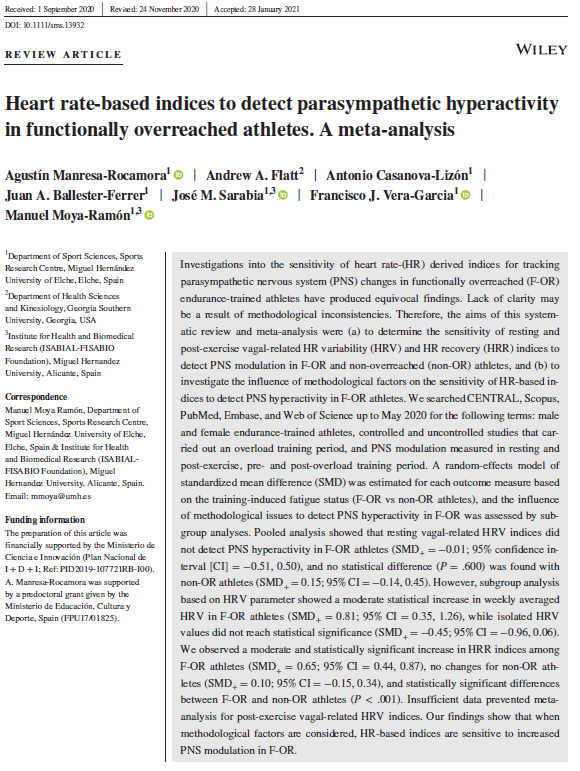
Heart rate-based indices to detect parasympathetic hyperactivity in functionally overreached athletes. A meta-analysis

Our new meta-analysis determined that parasympathetic hyperactivity in overreached endurance athletes is best detected using weekly averaged versus isolated HRV values and in the standing versus supine position.

Thanks to Agustín Manresa-Rocamora, Antonio Casanova-Lizón, Juan A. Ballester-Ferrer, José M. Sarabia, Francisco J. Vera-Garcia, and Manuel Moya-Ramón for inviting my collaboration.

The full text can be accessed at the link below:

https://onlinelibrary.wiley.com/share/author/WRPUS2WUBDYBTUBBUGQK?target=10.1111/sms.13932