Training Log: Week of Feb. 27 – March 4 2012

Monday Feb. 27– Squat Day

Morning HR: 60.8 HRV: 78.8

HRV was within baseline so I proceeded as planned. This week I work up to a single.

Warm up: Sled pushes, Skipping, Dynamic Stretches, Mobility

Squat: (after warm-ups) 405×3, 455×1, 475×1, 510×1

The goal for today was 520. I definitely could’ve hit 520 but none of my sets felt right. I was fighting the bar a little and just couldn’t find my grove. Here’s my 2 heavy squats in the video. Clearly I could’ve had more weight on the bar, but I made a judgement call based on how it was feeling and decided to stop after 510.

Front Squat – 135×5, 185×5, 205×5, 135 for 2×5 – I still suck at these and I still hate them. Keeping at it though.

GHR: 2×8

Reverse Crunch: 2×12

Deep Step Up: 2×6/leg

Band Pull Down Abs: 2×15 with light band


Tuesday Feb. 28 – Rest Day

Morning HR: 65.2 HRV: 77.6 – Not bad for the day after a workout

I warmed up, foam rolled, stretched and did some sled dragging for 22 minutes. 2 plates on the sled.


Wednesday Feb. 29 – Bench Day

Morning HR: 59.5 HRV: 77.6 – I was surprised my HRV wasn’t higher with my HR being that low. HRV was within baseline so I proceeded with the plan to work up to a single. Last month I missed 385 at lock out. This pissed me off. I was supposed to do 375 but I got greedy. Today’s goal was therefore 375.

Warm – up: Same as usual.

Bench: (after warm-ups) 315×3, 355×1, 375×1 (between sets of bench I did some easy inverted rows on the gymnastics rings)

Military Press: 135 for 2×9, 2×8 – just wanted to beat last week (between sets I did some easy band pull downs with the average band)

DB Incline Press: 80’s for 3×9 – like last week I did these really slow on the eccentric and paused for about 2 seconds at the bottom.

Ended it there.


Thursday March 1 – Rest Day

Morning HR: 66.2 HRV: 76.2

Did my usually recovery work. Foam roll, stretch, and sled drags.


Friday March 2nd – Deadlift Day (currently not actually deadlifting until my back is 100%)

Morning HR: 57.4 HRV: 84.3 – This was unusually high HRV for me. This could be a good thing or a bad thing.. I’ll have to wait and see.

Bent Over Row – 135 x10, 185×10, 225×8, 255 for 3×8 – I put the bar on the ground between each rep to engage my hams and glutes at the beginning of each rep.

RDL: 225×10, 245 for 3×10 – These felt ok on my back.. need to be careful not to overdo it.

Weight Pull Up: 25lbs on the belt, 3×8

Supine Hip Thrusts: 225 3×10 – these were pretty easy, working up slowly so I don’t get too sore. I like being fresh for squats on Monday.

DB Row: 100’s for 3×11 – elbows flared to hit the upper back.

No farmers walks today, the soccer team had to get their workout started.


Saturday March 3rd – Rest

Morning HR: 60.6 HRV: 82.9 – This is another high score for me. I’m slightly concerned. I haven’t deloaded in about 2 months. I never used to go more than 3 weeks without a deload week. I’ve been experimenting with not taking deload weeks but rather deloading on a given day if my HRV is low. So far it’s been working great. My body feels good, libido is good, joints feel good, etc. For now I’ll just interpret this as good recovery.

Went in to the weight room to do some recovery work. Instead of sled drags I opted for a 25 minute jog in the Gymnasium. I did laps around the perimeter of the gym and up and down the steps of the bleachers. I felt great after.


Sunday March 4th

Morning HR: 60.5 HRV: 82.1 – HRV was again above 80 which is typically a good thing.

This has traditionally been a rest day but last week I did some assistance work for arms and delts since I didn’t get to it on Wednesday after benching. I liked it last week so I did it again today.

I kept the weight really light and set the clock to 40 second beeps. Just focused on time under tension. We’ll see if these workouts make my arms grow!

That’s it for the week. Proceeding with caution next week. Unusually high HRV can be indicative of overtraining or even an illness coming on. Since I feel good though I’m assuming that this is not the case. We’ll see.

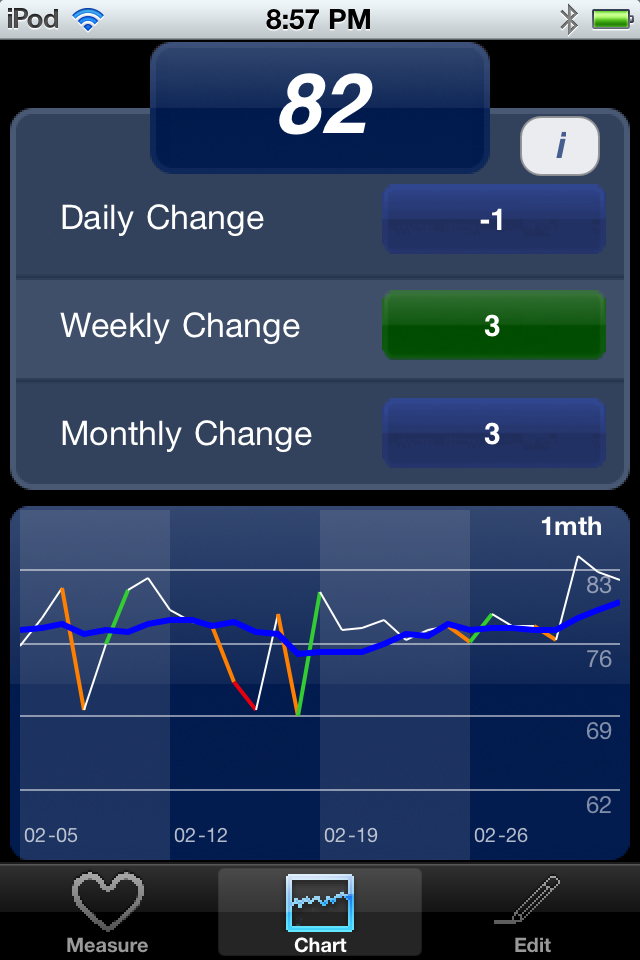
Here is a view of my HRV trend over the last month. Keep in mind This was my second month not taking a deload week. There were two workouts that I had low HRV (both on consecutive Wednesdays/Bench days. Those were my only deload workouts.

If you’re not assessing (the ANS), you’re guessing

“If you’re not assessing, you’re guessing” is a phrase often used by strength and conditioning professionals to explain the importance of movement assessment prior to exercise prescription. Prescribing a program that doesn’t consider the athlete’s movement ability (or lack thereof) can end up causing problems.Essentially, you would be guessing that your exercise prescription is helpful when in fact it could be exacerbating a problem. I wholeheartedly agree with this. However this article has nothing to do with movement assessment. This was just my way of illustrating what my next point is.

I am going to apply the same logic we use for why we assess movement (to influence program design) with monitoring the function of the autonomic nervous system (ANS); if you’re not assessing the ANS, you’re guessing.

If you’re unfamiliar with what the ANS is and why it’s important I suggest you read this. In a nutshell the ANS governs “rest and digest” and “fight or flight” responses in the body. This is done without our conscious control. The two components of the ANS are the parasympathetic branch and sympathetic branch. Sympathetic activity is elevated in response to stress be it physical, or mental. Adrenaline is secreted and catabolic activity (the breakdown of structures) ensues. Parasympathetic activity is elevated in the absence of stress and functions to heal and repair the body.

We can monitor our ANS status non-invasively and inexpensively through heart rate variability (HRV). I explain how you can do this here.

HRV as an indicator of autonomic function can tell you a tremendous amount about your athlete’s responsiveness to training. I shared plenty of research in this post that lends support to HRV as an effective tool for; reflecting recovery status, showing better adaptation to training and even predicting performance. In a separate post I shared my thoughts on HRV as a predictor for injury.

Let me summarize what I shared in my initial research review post;

HRV reflects recovery status in elite Olympic weightlifters (Chen et al 2011), national level rowers (Iellamo et al 2004) and untrained athletes (Pichot et al 2002).

Cipryan et al (2007) showed that hockey players performed better when HRV was high while performance was rated lower when HRV was low.

Endurance athletes who improved vo2 max had consistently high HRV while athletes who did not improve vo2 max had low HRV (Hedelin et al 2001).

Endurance athletes who trained using HRV to determine their training loads had a significantly higher maximum running velocity compared to athletes in a pre planned training group (Kiviniemi et al 2007, Kiviniemi et al 2010).

Female athletes who used HRV to guide their training increased their fitness levels to the same level as females in a pre planned training group but the HRV group had fewer high intensity training days (Kiviniemi et al 2010).

(references for the above articles can be found in my original post here.

I’d now like to show some more research that lends support to the usefulness of HRV in monitoring athletes.

Mourot, L (2004) saw decreased HRV in overtrained aerobic athletes. Uusitalo et al (2000) also saw decreased HRV in overtrained female aerobic athletes.

Huovinen et al (2009) measured HRV and testosterone to cortisol (T-C) ratio in army recruits during their first week of basic training. The training was class room based (not physical) and therefore all stress can be considered mental. The authors found that HRV declined in several soldiers, though not all. This demonstrates that, what can be interpreted as stress is highly variable and dependent on the individual. The authors used the terms “high responders” and “low responders” to describe the differences among soldiers. Immediately I thought about the differences among athletes and how their bodies perceive stress. You can’t assume everyone is responding in kind to a training program. What is stressful for one athlete may not be as stressful to another.

All soldiers that showed decreases in HRV also showed lower T-C ratios. In contrast, soldiers with higher HRV had higher T-C ratio’s. Baseline T-C levels were not recorded so we shouldn’t draw any concrete conclusions however it appears that low HRV (increased sympathetic activity with parasympathetic withdrawl) is associated with a reduced T-C ratio.

Hellard et al. (2011) found that in national level swimmers, as HRV dropped (sympathetic predominance) there was an increased risk of illness. The drops in HRV that lead to illness were preceded by a sudden increase in parasympathetic activity the week prior to illness. The authors speculated that the preceding increase in HRV (parasympathetic/vagal activity) was a reflection of the body experiencing the first incubation period and that an increase in vagal activity was a protective response trying to modulate the magnitude of early immune responses to inflammatory stimuli. The subsequent increase in sympathetic activity and decrease in HRV occurs during the symptomatic phase of the illness.

In humans, increased sympathetic activity is generally associated with inflammatory responses while parasympathetic predominance actually inhibits inflammation. At this point in time I will not elaborate on this for the simple fact that I don’t fully understand it. However, we can speculate that if we’re seeing consistently low HRV scores in ourselves or our athletes there is probably an increase in inflammation occurring. Check out Thayer (2009) for more information regarding HRV and inflammation. Simon from iThlete sent me that paper and I’m still processing it.

When dealing with a team or if we train multiple athletes at the same time we need to be aware of how they are adapting and recovering from training. Work by Hautala et al (2001) shows that athletes will recover from exercise at different rates according to fitness levels (obviously). Basically, fit individuals recover faster and show less HRV fluctuation compared to less fit individuals. In a team setting, some individuals who are highly fit may not be getting a sufficient training stimulus while other athletes who are less fit can be overworked.

Kiviniemi et al (2010) found that females take longer to recover from aerobic training than males. This needs to be considered if you are training a mixed gender group.

Buchheit et al (2009) and Manzi et al (2009) both found HRV to be a predictor of aerobic performance.

I’m well aware that the development of athletes has been taking place without the use of HRV monitoring. There are many great coaches and trainers who have their own systems and methods of monitoring recovery in their athletes that work well.

HRV is a tool to use within your own systems. I have thoughts about how I would implement this in a team setting that I will share another time.

To truly autoregulate the training of ourselves or of athletes, we need as much information about present physiologic status as possible. Based on the research and my own personal experience with HRV, this technology takes much of the guesswork out of load/volume manipulation and training prescription. Training hard when HRV is low can be counterproductive and delay recovery. Training hard when HRV is chronically low can lead to illness, injury, overtraining syndrome and suppressed testosterone. Alternatively, increasing load/volume on days when HRV is high can lead to more favourable adaptation. HRV can tell us how stressful the training was for our athletes based on how long it takes HRV to reach baseline in subsequent days. HRV can indicate how much stress your athlete is experiencing outside of training. There are several indications one can take from a simple HRV measurement. Further research will reveal more correlation between HRV and sports performance.

I believe that to train an athlete optimally, we need to be assessing the state of the autonomic nervous system… otherwise we’re guessing.

References:

Buchheit, M. et al (2009) Monitoring endurance running performance using cardiac parasympathetic function. European Journal of Applied Physiology, DOI 10.1007/s00421-009-1317-x

Hellard, P., et al. (2011) Modeling the Association between HR Variability and Illness in Elite Swimmers. Medicine & Science in Sports & Exercise, 43(6): 1063-1070

Huovinen, J. et al. (2009) Relationship between heart rate variability and the serum testosterone-to-cortisol ratio during military service. European Journal of Sports Science, 9(5): 277-284

Kiviniemi, A.M., Hautala A.J., Kinnunen, H., Nissila, J., Virtanen, P., Karjalainen, J., & Tulppo, M.P. (2010) Daily exercise prescription on the basis of HR variability among men and women. Medicine & Science in Sport & Exercise, 42(7): 1355-1363.

Manzi, V. et al (2009) Dose-response relationship of autonomic nervous system responses to individualized training impulse in marathon runners. American Journal of Physiology, 296(6): 1733-40

Mourot, L. et al (2004) Decrease in heart rate variability with overtraining: assessment by the Poincare plot analysis. Clinical Physiology & Functional Imaging, 24(1):10-8.

Thayer, J. (2009) Vagal tone and the inflammatory reflex. Cleveland Clinic Journal of Medicine, 76(2): 523-526

Uusitalo, A.L.T., et al (2000) Heart rate and blood pressure variability during heavy training and overtraining in the female athlete. International Journal of Sports Medicine, 21(1): 45-53 


Training Log from week of Mon Feb. 20th – Sun Feb 26th

From now on I will post one training log update every week as opposed to separate posts for each workout. This will make it much easier to see how my HRV fluctuates from day to day.

Monday Feb 20th

Morning HR: 66.6 – HRV: 77.3

Bodyweight: 224

HRV was within baseline so I proceeded with original plan which was to work up to a few sets of 2 with a weight I could do 3 reps with.

Warm up: Foam roll, sled, skip, dynamic stretches, some mobility… ready to rock.

Squat – 485 for 2×2

Front Squat – 185×6, 205×6 – I couldn’t get my groove on these so I stopped after that set.

Walking DB Lunges – 40’s for 2×11/leg                                                                                      Barbell Roll Outs – 2×6                                                                                                               *Superset

GHR – 2×10

Landmines – 2×10/side

Tuesday Feb 21st

Morning HR: 68.7 – HRV: 77.5 Higher than I expected after the squat day.

I did some foam rolling, stretching and 20 minutes of sled dragging. Forward and backward with 2 plates on the sled

Wednesday Feb 22rd

Morning HR: 61.3 – HRV: 78.3 Another baseline score which I was happy to see for bench day.

Warm up – same thing as last time

Bench – 340 for 3×3

The plan was to do 355 but the weight felt heavy today. This was probably because for the last 2 weeks in a row on Wednesday’s I had low HRV and therefore didn’t bench too heavy. The weight always feels heavy after a few workouts not lifting heavy.

Military Press – 135 for 4×8

DB Incline Press – 80’s for 3×8

I performed these really slow and paused in a deep stretch at the bottom. I was sore the next day.

I ended it here. I typically do some arms and delts, but wasn’t feeling it.

Thursday Feb 23rd

Morning HR: 68.5 HRV: 76.3 – heart rate was a bit high and HRV was a bit low. This is pretty standard for the day after a lift.

Did some foam rolling, stretching and some light sled work for recovery.

Friday Feb. 24th

Morning HR: 64 HRV: 77.2 – Within baseline

This would typically be my deadlift day but as I mentioned in my last entry for Friday I am temporarily stopping deadlifting until my back is 100%. My workouts now focus on movements that will help build the deadlift.

Warm Up – Same routine

Bent Over Row – 245 for 4×8

RDL – 185×12, 225 for 3×12 – these made my hammies real sore over the weekend. RDL’s didn’t bother my back so I’ll definitely be doing these again.

Weighted Chin Up – 25lbs on the belt for 1×9, 2×8

DB Row – 100 for 3×10 – kept my elbow flared to hit my upper back

Farmers Walks – Loaded up 2 trap bars with 135 on each and did 4 walks for about 20 seconds each. The turns are what makes these so difficult. I could walk straight with these for a long time but the weight room isn’t a mile long so I have to make frequent turns.

Saturday Feb. 25h

Morning HR: 64.1 HRV: 77.7 – A decent score for a day after a lift

Did some stretching, mobility and sled dragging. Nothing strenuous.. just got a light sweat and kept my heart rate up for about 20mins

Sunday Feb. 26th

Morning HR: 65.6 HRV: 76.1 – Expected HRV to be higher

I went in to the weight room to pump the arms and delts since I didn’t do them on Wednesday.

Nothing really to report, I used really light weight and focused on time under tension and strong contractions. I didn’t want to do anything that would affect my HRV score for squatting the next day. My arms were sore as hell today (Monday) which is awesome.

That’s it for that week.

Deadlift 02/17/2012

Thursday HR: 75.9 HRV: 69.6 – low because I pushed it a little too hard on Wed.

Friday HR: 67.8 HRV: 78.8 – Deadlift Day – workout below

Saturday: HR: 74.1 HRV: 69.1

Deadlift Workout: I have decided to stop deadlifting until my back heals to 100%. Deadlifting is the only exercise that really bothers it. In the mean time my Friday workouts are going to consist of exercises that will still help build and strengthen the muscles used in the deadlift. Here’s what I did;

Bent Over Row: 225 for 5×8 – Haven’t done these in forever. Kept the weight moderate to see how my back felt. Everything felt good! I want to get this lift real strong now.

Good Morning: 225 for 3×6 – These don’t bother my back at all for some reason. Kept the weight moderate because these tend to make my ham’s really sore. I want my legs fresh for Monday’s squat workout. I’ll build this lift up slowly over the next few workouts.

Weighted Chin up: 25lb plate attached to belt for 4×8
Barbell Hip Thrust: 135 3×10 – first time trying these, incredible glute exercise. I’ll load these up much heavier next time.
*Superset

DB Row – 100’s for 3×8 – kept my elbow flared out and rowed the db to my armpit to hit the upper back.

Farmers Walk: Loaded up 2 trap bars with 135lbs. Did 4 carries for about 20 seconds each. First time doing these. Really trying to build some grip strength.

My HRV today was really low as I mentioned above. I am pretty sure it’s because yesterday’s workout was very different from what I typically do. The new exercises obviously put a big stress on my body. I was expecting a low HRV score. I’ll rest today and tomorrow and should be good to go for Squat day on Monday.

Bench 02/15/2012

Tuesday HR: 67.9 HRV: 77.6 – Off Day – Did some light sled dragging to pump some blood in my legs

Today HR: 71.9 HRV 72.3

A low score today. I had a low score last Wednesday too. Two weeks in a row not benching heavy is rough! I typically don’t work up to 315 on a de-load day but I had to move something I didn’t have to be embarrassed about.

Here’s what I did;

Bench: worked up to 315 for 1 set of 5

Incline DB Bench: 80’s for 2×10
Chest Supported Row: 80’s for 2×10

Standing Barbell Triceps Extensions: 75lbs for 2×12
DB Curl: 50’s for 2×8

DB Laterals: 30’s for 2×10
Inverted Rows on Rings: 2×10

My HRV better not be low next Bench day!


Squat 02/13/2012

Sunday: HR 60.8 HRV 79.3 – Did some light recovery work (stretch, foam roll, skip)

Today: HR 66 HRV 78 – Squat Day

Squat: Worked up to 455 for 3×3                                                                                                    Some days the weights feel light and sometimes they don’t. Today they didn’t feel light. I only did 3×3 because my HRV was decent. Curious to see how my HRV responds tomorrow. (I’ll only post a video from now on when I do something worth posting)

Front Squat: 135×6, 185×6, 205×6, 225×6

Deep Step Up – 2×8 each leg                                                                                                                    Ab Wheel Roll Outs – 2×8

GHR – 2×10                                                                                                                                                       Reverse Crunch – 2×10

That’s it. Not great, not terrible.

Can HRV predict injury?

In my first post on HRV I highlighted what I thought to be HRV’s most promising attributes. I would like to add another to that list;

HRV may be able to tell you when you’re at a higher risk of injury.

After one of many e-mail based discussions I’ve had with Simon Wegerif  (creator of iThlete), he  happened to put this idea in my head. I told him about the study we are trying to run here at Cal U where we will compare HRV guided training vs. pre-planned training in off-season collegiate football players. We are looking to see if one method is better than the other for increasing strength. Simon mentioned that we should consider looking at illness and injury among the players as well. He followed up this suggestion by mentioning some research done by a veterinarian who found a correlation between low HRV scores and increased injury rates among race horses.

I immediately began scouring several databases for any research to show HRV as a predictor for injury potential. My search proved to be futile as nothing of note came up. I was however, able to get my hands on the article on race horses Simon had mentioned.

In a nutshell, Dr. Christine Ross monitored the HRV of 16 competitive race horses, all of which were in training. Of the 16, 13 had HRV readings that were associated with pain, fatigue, illness or injury. It was stated that even though the horses appeared healthy and energetic, they were considered “at risk” based on their HRV. There were no outward signs or symptoms to suggest these horses were currently sick or hurt. Within 3 months, 12 of the 13 at-risk horses got injured or sick requiring veterinary intervention and cessation of race training. (Message me if you would like to see the article)

The results of Dr. Ross’ findings are staggering. Can HRV detect the same issues with humans?

Naturally, I began thinking of all of the injuries I’ve had over the years from football, hockey, lifting, etc.

Since I’d only been measuring my HRV for the past 7 months I focused on injuries since mid-August. I just so happened to have injured myself once during this time period. Through my training log I was able to pinpoint the exact day. It was Oct. 11, 2011. During a set of squats with about 60% of my 1 rep max on the bar, I pulled a muscle in my lower back. This injury kept me from lifting for about a month. I cross referenced that day with my HRV scores. Sure enough, my HRV was extremely low at 66.4 and my heart rate that morning was 83.8 beats per minute. Keep in mind that at this time I was simply taking my HRV score for observational purposes and not using it to guide or manipulate my training. In the image below you can see the large downward deflection in HRV from early October when I hurt my back.

Back Injury in October HRV Score

Typically only conditioning workouts or illness cause my HRV to drop so dramatically as I explained previously in this post. In this instance, I had not performed a conditioning session nor was I sick in any of the days prior to the injury. What caused such a significant drop in HRV? Well, that weekend I was in Ohio for my grandmother’s funeral. My best guess is that the emotional stress in addition to the stress from travelling caused this drop.

I wish I had more than animal research and anecdotal experience to share on this topic. I will keep my eyes peeled for any further evidence on this topic. I’m sure coaches who have been monitoring the HRV of their athletes would be able to provide some better insight on the matter.

If HRV happens to be an accurate indicator of a heightened risk of injury (among many of its other purported attributes), would you be monitoring your HRV? If you are a coach, would you want to know the daily HRV scores of your athletes? If one of your starting football players was showing poor HRV scores on a day where you were going to have them perform tackling drills in practice, would you have him sit out? How would you manipulate strength and conditioning training based on your athletes HRV scores?

I hope to shed some light on this topic with the research we are trying to do here at Cal U. I want to monitor the HRV in both training groups and observe what may happen to an athlete in the pre-planned group who may be having low HRV scores. Though we will be measuring strength, we can still observe if and when athletes get sick or hurt.

I’m happy to report that we recently received a sample HRV device from Polar (the RS800 Watch). Our fingers are crossed that we can work something out to get several more for the study!

Download IMG00944-20120211-1535.jpg (245.5 KB)

Have a good weekend!

Deadlift from 02/10/2012

Thursday Morning HR: 67.6 HRV: 75.9 – Rest Day

Friday Morning HR:61.6 HRV 81.1 – Deadlift

Saturday Morning (today) HR: 55.1 HRV: 82.3

Body weight: 223

Looks like deloading on Wednesday paid off. My HRV was still poor on Thursday but jumped back up for yesterdays Deadlift workout. I can definitely feel the difference physically when my HRV is poor and when it’s high.

Friday’s Workout looked like this;

Deadlift: 135 1×5, 225 1×5, 315 1×5, 36  1×1, 405 1×1, 425 1×1, 445 1×1, 465 2×1            I stopped there as my back started to act up a bit at this point. I’m anxious to put some more weight on the bar and move something decent but it’s just not worth a major set back if my back gets messed up.

RDL’s: 225 2×10

Chest Supported BB Row (pause at top): 135 1×10, 155 3×10                                                     Sit-ups on GHR: 3×10

Chin Ups: 3×10                                                                                                                                               GHR: 3×8

Overall, I was happy with the workout. I’m going to focus on strengthening my back to keep a solid neutral spine when deadlifting. If my technique is flawless usually there is no pain. This is a blessing and a curse. I had a big meal after and a great sleep last night. I was pretty surprised to see my HRV so high the day after a workout. I’m sure if I had done some heavier deadlifting with more sets it wouldn’t be so high. 465 really isn’t going to stress my body out that much.

Bench 02/08/2012

Morning HR: 77.6 HRV: 69.6

This was an unexpectedly low score. I measured it 3 times to be sure. I was looking forward to benching some decent weight today, but my HRV score put the kibosh on that plan. I woke up at 6am and tossed and turned for over an hour before I fell back to sleep. When I woke up again around 9:15am I had a mild head ache. I usually wake up around 8am. I knew at that point I probably wasn’t going to have a great HRV score. My HRV yesterday was great with a score of 81.2. Yesterday was a rest day though so I didn’t train. A possible explanation for the low score today is that normally I would be de-loading this week. This is my fourth week with straight lifting when typically I’d deload after 3.

Here was what I did in the gym;

Warm up: Skipping, Sled pushes, Dynamic stretching

Bench Press: 135 1×5, 185 1×5, 225 2×5                                                                                 Inverted Rows on Rings: 4×8

Pull Ups: 2×8                                                                                                                                             Dips: 2×10

Band Curls: 2×25                                                                                                                                     Band Push Downs: 2×25                                                                                                                            DB Laterals: 20’s for 2×10

The workout was less than 30 minutes including the warm-up. I ate a much bigger dinner than usual after because I felt I could use the extra calories. Curious to see what my HRV is tomorrow.

Squat 02/06/2012

Morning HR: 64.2 HRV: 78.4

This score is within baseline so I proceeded with the workout as planned. This week I will be working up to 2×2 with a weight that I could do 3 reps with.

Squat: 135 1×5, 225 1×5, 315 1×3, 365 1×3, 405 1×2, 455 1×2, 475 2×2

I was pretty conservative with picking 475 because in my experience, I usually end up paying for it if I get too greedy. After doing the sets I probably should have  had another 10-20lbs on the bar to really reflect a 3 rep max weight. I don’t regret it though. I recorded the first set at a back angle and the second set at a side angle. I’m happy to say that my back felt fine all workout. It’s really just deadlifting that seems to aggravate it.

Front Squat: 135 1×6, 185 1×6, 210 2×6 – Just wanted to beat last week. Still hate them.

Deep Step-Up: 3×8 each leg                                                                                                                         Pikes on Swiss Ball: 3×10                                                                                                                               *Superset

GHR: 2×8                                                                                                                                                         Pot Stir: 2×6 each direction                                                                                                                         *Superset

Looking forward to bench day!